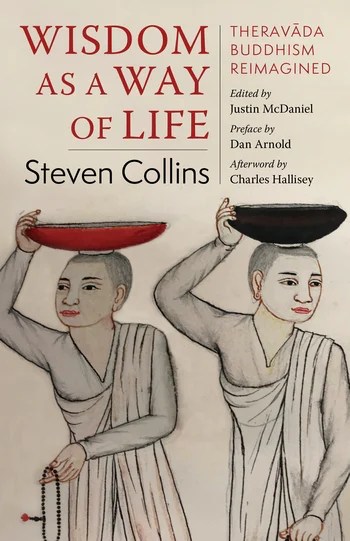
The book represents the last contribution to Buddhist studies and to the intellectual histories of civilizations by Steven Collins (1951-1918). Steve had finished a complete first draft only a few months before his untimely death in February 2018 and had gone as far to circulate the manuscript among a number of close colleagues and friends.
A world-renowned scholar of the Pali Buddhist traditions of Southeast Asia, Steven Collins was at the time of his death the Chester D. Tripp Professor in the Humanities in the Department of South Asian languages and Civilizations and in the Divinity School at the University of Chicago, where he spent almost three decades of his influential career. By the untimely end of his life, Steve had for many years been interested in what he called “practices of the self” – and idea informed by Michael Foucault’s theorization of “technologies of the self” and by Pierre Hadot on philosophy as “a way of life.”
The ten takeaways I got out of this book are outlined below:
- The Theravada presents a list of ten forms of excellence, of which wisdom is the fourth: generosity, virtue (or morality, sila), renunciation, wisdom, energy, patience, truthfulness, determination, loving-kidness (friendliness, metta), and equanimity.
- The OED has for “wise”: “having or exercising sound judgment or discernment; capable of judging truly concerning what is right or fitting, and disposed to act accordingly; having the ability to perceive and adopt the best means for accomplishing an end; characterized by good sense and prudence.”
- Talking animal stories: Why do people tell them? – telling animal stories, so very common in The Birth Stories, is such a familiar practice worldwide, known from childhood on, that it might seem odd to ask why we tell them… First, of course, it is just because they are entertaining: a good example where the pleasure of the text is the confrontation with the unfamiliar… There is also an inherent irony in such stories, where the animals obviously represent in some way (in fact, various ways) forms of humanity. We can be shown to be, sometimes by turns, foolish, wise (or apparently so), thoughtful, impetuous, greedy, cruel, and so many other things, either by exaggeration or by the sheer fact of our being, whether explicitly said or just by implication, worse than, the same as, or better than the animals in the stories.
- Wisdom in Systematic Thought – the idea of ‘wisdom’ is, naturally, that textual world where something called “enlightenment,” which does not exist in the historical world, is used as a category applied to either aspirants to nirvana or those who have attained it. Wisdom is here said to mean various things, all of them “spiritual.” What is meant here is, for the external analyst, the gradual and then complete introjection of Buddhist ideology. Wisdom here is “seeing things as they really are”: that very conditioned existent is unsatisfactory and impermanent; that very existent, conditioned or unconditioned (that is, nirvana) is without self; or the doctrine (and general idea) of dependent origination; or the understanding as well as the practice of bhavana, askesis and the like.
- Diversity and Unity – we live (experience) diversity; we (may) think (construct) unity. One does not have to think unity: one can leave the diversity of everyday life in place. More than once Was Weber quoted James Mill’s remark that “if one proceeds from pure experience, one arrives at polytheism.” Weber used Mill’s remark metaphorically: “polytheism” for him referred not to supernaturalists ideas and practices but to the many “value spheres in the world (that) stand in irreconcilable conflict with each other.” He opposed any attempt on the part of intellectuals to impose a unifying ideology to it. And diversity is what The Birth Stories (and proverbs) express.
- Buddhists are people first (who can enjoy stories from anywhere), ‘Buddhists” second.
- No self, but many words for persons – the most basic and important idea of Buddhism systematic thought is the denial that there is any permanent, continuing self behind experience, and across the series of lives in samsara: the doctrine of anatta, non-self.
- In Foucault’s words, “spirituality” is distinguished from “philosophy” in the following ways: we could call “spirituality” the pursuit, the practice and experience through which the subject carries out the necessary transformations on himself in order to have access to the truth. We will call this “spirituality” the set of these pursuits, practices, and experiences, which may be purifications, ascetic exercises, renunciations, conversions of looking, modifications of existence, etcetera, which are not for knowledge but for the subject, for the subject’s very being, the price to be paid for access to the truth.
- “I hope to have introduced Theravada Buddhism in a new way, to anyone that is interested. Classifying Buddhism as a “religion”, immediately makes one think, Ah, a religion: it will then have a life of the founder, an early history, basic doctrines, later developments, and so on. And this, indeed, is the model for most of the surprisingly many “introduction to Buddhism” books on the market. I have chosen otherwise. I don’t know in what institutions, if any, the book will be read. I just wrote it as I see it. Evincing complete skepticism with regard to any knowledge of the life of Buddha (if there was one), and of its ‘early history’ and ‘doctrines,’ I have chosen to see Theravada intellectual history.
- The four Collins questions – students, colleagues, and friends of Steven Collins remember, with considerable affection and appreciation, that there was always a moment in a collective review of a dissertation proposal, or a project proposal when he would ask four questions directly. This became so routine for such occasions that they have been dubbed “The Collins Questions.” They are: What is your question? What is your archive? Is your archive adequate? Why is your question important?
 Marco Serrato
Leave a comment