
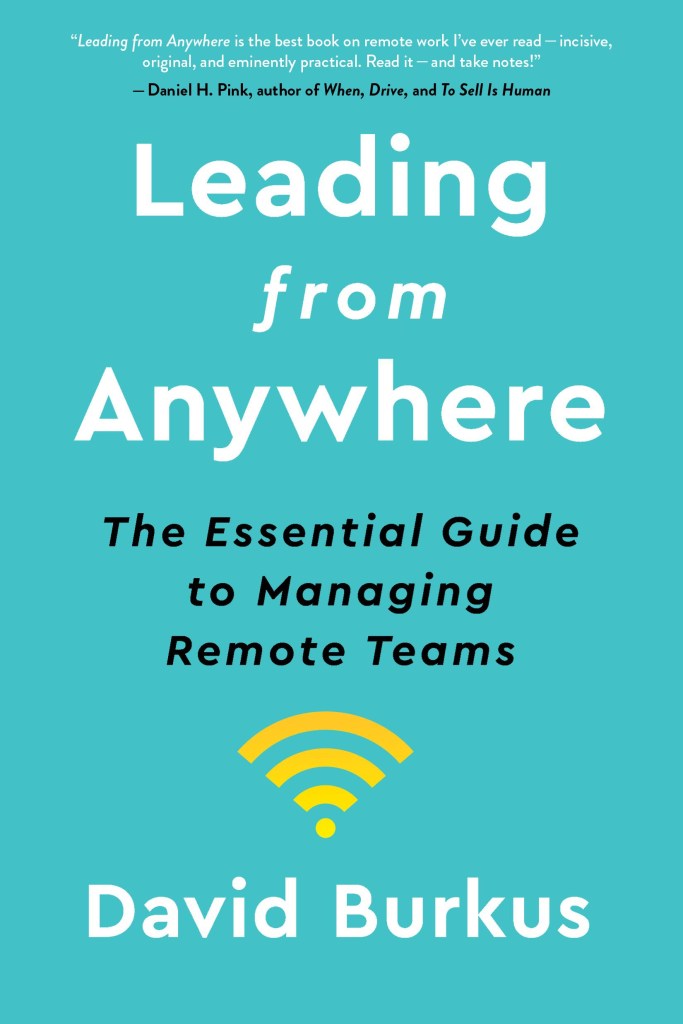
This book is written by David Burkus, author of four award-winning books and ranked as one of the world’s top business thought leaders by Thinkers 50. He also has a TedTalk that has been viewed over 2 million times.
The fifteen main takeaways I got out of this book are outlined below:
- It’s difficult to trace the origins of remote teams. On some level, they’ve always been a reality. The Roman Empire stretched across three continents, but Ceasar had to settle for roads and messengers. At the height of its colonialism, it was said the sun never set on the British Empire, but Queen Victoria had to keep it all together using ships and trade routes. Even in the relatively short history of the United States, circuit riders coordinated to preach across the growing country and traveling salesmen went door-to-door even before the automobile to maximize revenue for their companies and themselves.
- The COVID-19 pandemic and response will be remembered for a lot of things, almost all of them tragedies. But it will also be seen as the push needed to get the remote-work movement to critical mass. Now that most managers have seen firsthand the benefits and challenges of remote work, most have recognized that the rewards significantly overweight the risks – and will continue to do so as developments in technology decrease those risks.
- “At home, people don’t experience what we call the ‘cake in the break room’ effect” – all leaders should be developing a plan to make their work arrangements permanently flexible. Many employees will be permanently working from anywhere; which means you need a plan to lead from anywhere.
- Going remote – get your team to a place of shared understanding, shared identity, and shared purpose… How do you make people feel like a team when they are not physically together? How do you help them collaborate when they can’t just walk to each other’s cubicles? How do you keep them aligned and motivated at hand, even when they are working in different tome zones or juggling responsibilities at home?… Shared understanding: refers to the extent to which members of the team have a commonly held perspective on the team’s expertise, assigned tasks, context and preferences. Different members of the team have different skills, abilities, and knowledge. Ona remote team, it’s likely that they’ll also come from different cultural contexts and different contextual constraints… So developing a shared understanding makes coordinating roles easier and collaboration faster. It’s a crucial first step in bringing a remote team together or taking an existing team remote… Shared identity: refers to the extent to which team members feel the same sense of who they are as a designated group. It indicates whether or not individual members truly feel like this is the team they’re part of and most loyal to… A strong identity in a team reduces conflict, standardizes norm behavior, increases cohesion and collaboration, and ultimately enhances team performance… One powerful way to develop a bond between team members is to point to the team’s superordinate goal – the objectives that affect everyone in the group… Shared purpose: people want a sense of purpose, and they want it for more than just their personal lives – ‘What are we fighting for?’ (Not ‘who are we fighting?’). We are talking about long term purpose. It could be a Revolutionary Fight (changing the status quo), an Underdog Fight (taking on the established players in an industry and winning through a better way of operating), or an Ally Fight (about the customers’ or stakeholders’ fight and how your work helps them win their battle. People don’t want to join a company; they want to join a crusade – so we need to continuously remind people how the work they’re doing is advancing the cause.
- Team’s Culture – there are five elements that explain how the best teams became the best teams: a) dependability (the extent to which team members were accountable to shared expectations); b) structure and clarity (whether the team had established roles and rules of engagement); c) meaning: how much the team felt their work had significance; d) impact (how much the team felt their work made a difference); e) psychological safety (how much the team felt they could be vulnerable and authentic with one another)… Trust is reciprocated: demonstrate that you trust your team to get their work done without being constantly monitored… Share your thoughts and concerns openly and your team will feel trusted with your vulnerability and will respond in kind. Admit mistakes and your team will feel like they can trust you and admit their mistakes to you. Take responsibility for performance concerns and your team will feel like they can do the same, instead of shifting blame somewhere else.
- Communication and collaboration become even more important in a distributed team. And not just communicating status updates or making comments on a shared document. Receiving and responding to feedback on their own work was a top-tier skill needed by everyone in the company.
- Some questions for hiring remote teammates – What does your ideal team look like? How often do they interact, and how do they treat each other? In what type of culture do you feel you do your best work? What was it like working on your last team? Have you ever been on a team that just didn’t work well? What was it like? How do you like to keep in touch with team members? What type of communication do you prefer? Tell me about a time a colleague completely misunderstood you. How did you resolve it? How often did you proactively reach out to team members or your manager in your last job? How do you organize your day-to-day tasks? How do you stay motivated when working alone? Tell me about a project you took on all by yourself. How did it go? How do you limit distractions around you when working? The goal is not to find the candidate with the best answers. The goal is to find the candidate whose existing communication preferences match those of your team.
- Onboarding your new hire – prioritize connection over documentation. Schedule a welcome video chat for the while team to meet and greet their new colleague. If synchronous communication isn’t an option, have each existing team member send a short welcome and a reason why they are excited to see your new hire join the team… Newbies helping newbies is often the best strategy… Also, if possible, add an in-person component to the onboarding process… Lastly, make sure the day begins and ends with a one-on-one with you.
- Building bonds from afar – find time for fika: the Swedish tradition that translates simply as “to have coffee,” fika is much more than just getting a warm drink. Fika is a ritual meetup between two people taking a break from work and socializing. The coffee is just the excuse to connect…In the digital version, two people partner to take a short break and chat about topics… Hold office hours – and encourage others to do the same… Host office scavenger hunts (teammates are asked to look around them and grab items that are meaningful to them)… Create team rituals – for as long as humans have formed tribes, they’ve used rituals to bond those tribes together. Most high-performing teams regularly engage in shared rituals because they create a sense of group identity and trust… If you also can, plan on-sites. Ideally, a company with remote teams is getting all its employees together on a fairly regular basis.
- Communicating virtually – it means setting the right expectations about what types of communication are used and how often. The goal is to be able to talk about the work being done and still leave enough time to actually do it… Communication implies: a) asynchronous (email, message boards, comments on shared documents, or group chat) options… Write clearly and concisely… Don’t assume widespread consensus… Infuse positivity into your writing… Assume positive intent when reading messages from others… b) synchronous communication – check yourself before going on camera… know how to make eye contact… Resist the urge to jump on a call or videoconference with someone every time you want to communicate something.
- Running virtual meetings – done well, they can be an exciting opportunity to build connection between your people and give them greater clarity on the tasks on hand… Plan with purpose… Pick the right invitees, and only the right ones… Build the right agenda… Open the line some minutes early… Capture minutes… Stay on topic… Close with a review… Leave the line open… Tips to make virtual meetings better: share the pain (time zones); everyone on video or no one; minimize presentation time; use names often and encourage others to do the same; start positive; break it up (provide frequent breaks if necessary); break it out; keep a chat box open.
- Thinking creatively – start with a problem meeting and then call an idea meeting to end with a decision meeting; facilitation matters when generating ideas (open with a warm-up; cameras on, mute off, notifications off); ideas are not bad – but assumptions can be wrong; leverage silence; use breakouts to make a large meeting smaller.
- Managing performance – abandon the idea that presence equals productivity… The real job is to learn how to track progress and get the feedback needed to do the best work… Focus on the outcome, bot activity… The managers who leverage autonomous motivation need to help their people through three activities: setting objectives (do it mutually; agree on intent; shorten the timeframe); tracking progress (the most potent factor in our motivation is the feeling of making progress; check in personally and regularly; check in with different people differently; communicate back to the team); and giving feedback (separate people problems from process problems; make feedback clear and constructive; focus on the impact behind actions; don’t just talk – listen; collaborate on a solution)… Managing performance is one of the most vital aspects of leading remote teams, but also one of the most difficult for new remote-team leaders.
- Keeping engaged – Avoid burnout; develop an after-work ritual; get outside; build work/life boundaries; build people boundaries; batch tour tasks.
- Saying goodbye to a teammate – Show appreciation and excitement; ask how they want to handle the announcement; prepare your own comments; make a plan for the details.
The website davidblurkus.com/resources presents additional resources like templates, videos, worksheets and more.
Overall, the author claims the added flexibility offered by remote work has not come at the cost of productivity. He cites a 2020 Gallup Study to support this statement since it states that the most engaged employees were at the office just one or two days a week. He claims that ‘absence makes engagement stronger’ (as long as it is not total absence) and that “Remote work will not solve every problems leaders face. There will always be more. But we will solve them together. And we will solve them with the brightest minds from all over the world. Because we can solve them from anywhere.”
 Marco Serrato
Leave a comment