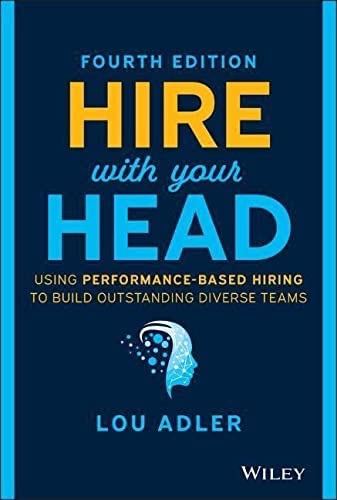
The book is written by Lou Adler and, while it was published back in 2007, presents valuable insights to identify and attract talent which are relevant nowadays. I went through this book after I joined Arizona State University’s Learning Enterprise in August 2021, since it is one of the core references used within our leadership group.
The book introduces us to the Performance-based Hiring system, a methodology designed in response to the needs of top recruits and based on how they actually look for and accept offers. This unique, step-based system involves, among other things: writing compelling job descriptions that emphasize the opportunities and challenges, not just the skills and qualifications required; focusing every aspect of your sourcing-job descriptions, Web copy, phone calls, all communications on attracting top people; using the interview process to both assess competency and entice the candidate with a rewarding career opportunity; and integrating each step in the hiring process, combining recruiting, interviewing, negotiating, and closing into one smooth process.
The eight main takeaways that I got out of this book are outlined below:
- Performance-based hiring – there is nothing more important to a manager’s personal success than hiring great people. Management is easy as long as you clearly know the performance needs of the job and hire great people to do it. Hiring is too important to leave to chance. Hiring is the only major process in a company that’s random. Any other process that’s this unreliable would have been redesigned long ago. The key to better hiring decisions is to “Break the emotional link between the candidate and interviewer and substitute the job as the dominant selection criteria.” Measure a candidate’s ability to do the job, not get the job. Determine whether you like or dislike the candidate after you’ve determined his or her competence. Substance is more important than style, but it’s sometimes hard to tell the difference. Great hiring requires more than just good interviewing skills. Performance-based Hiring brings everything together into an integrated, systematic core business process. “Hire smart, or manage tough” – Red Scott.
- Hiring with a performance profile – if you want to hire superior people, first define superior performance. Minimize the use of traditional job descriptions as part of the sourcing and selection process. A performance profile describes the required results, the process used to achieve the results, and the environment in which this happens. Define the job, not the person. Define success, not the skills. It’s best to separate the job from the person. This allows for a more objective appraisal of true competency. Focus on the doing, not the having, to improve hiring accuracy. It’s what a person does with his or her skills that determines success, not the skills alone. Experience and personality are poor predictors of subsequent performance. It’s better to define and use the real performance needs of the job to screen and interview candidates. Every job has six to eight performance objectives that define on-the-job success. These range from dealing with people, meeting technical and business objectives, to organizing teams, solving problems, and making changes. To develop the list of performance objectives, ask the hiring manager what the person taking the job needs to do throughout the first year to be successful in the job. To expand the list of performance objectives, convert each qualification listed on the traditional job description into a measurable task. For entry-level or process-oriented positions, benchmark the best (and worst) people already doing the job. Use this to create performance objectives for any type of position. The performance profile establishes the framework for better hiring and better management by clarifying the expectations for the job. This improves on-the-job performance, requires less day-to-day management, and reduces turnover.
- Talent-centric sourcing – implement a multichannel sourcing strategy. You’ll need this to counter the increase in workforce mobility and maximize candidate quality while reducing time-to-fill and cost-per-hire. Use the hub and spoke concept to massively upgrade your career web site. Your company career web site should be an inviting place where top people can find jobs quickly. Make your advertising visible. Work hard using search-engine optimization and reverse engineering techniques to make sure top people can find your jobs. Offer careers, not jobs. Don’t post traditional job descriptions; these are boring and counterproductive. You’ll find your best candidates in the sourcing sweet spot. Build your active and passive sourcing programs around how the best people in each group look for new opportunities. Be fast. Be different. To compete for the best, you must be different from your competitors. To hire the best, you must move fast. Re-design everything with these two ideas in mind. Recruit first, network second. The best people will give you the names of other good people if you build a personal relationship with them first. Recruiting them directly is the shortest way to build a relationship. Implement a proactive employee referral program. Your current employees know many great people who aren’t looking. Ask them who they are and then recruit them. Implement workforce planning. Planning and forecasting resources and needs are at the core of good management. A workforce plan provides the time to find the best people available, not the best available people.
- Performance-based interviewing – review the performance profile and the top performance objectives before the interview. Use these performance objectives to guide your fact-finding. Read and annotate the candidate’s resume. Know the candidate’s strengths and weaknesses before the interview, then use fact-finding to validate them. Conduct a 20-minute preliminary phone interview before meeting the candidate. Focus on the work history review and one or two major accomplishments. This will eliminate unqualified applicants sooner and minimize emotions for those you meet. Ask the candidate to submit a short addendum to his or her resume describing one team and one individual accomplishment. This quickly establishes the performance-based nature of the interview. Measure first impressions at the end of the interview. Put your emotions in the parking lot. Sometimes even top salespeople make average first impressions, so don’t exclude anyone too soon. It’s the answers, not the questions that count. Turn generalities into specifics. Get examples and quantify everything. Ask for facts, figures, dates, names, and measurements. This will reduce exaggeration and validate responses. It will also quickly minimize candidate nervousness. Be skeptical. Interviewing is a fact-finding mission, not a popularity contest. As long as you know what you’re looking for, don’t give up until you find it. As long as the job is great, great candidates won’t mind. The Formula for Success = Talent* Energy^2 + Team Leadership + Comparable Past Performance + Job-Specific Problem Solving. Anchor and visualize each performance objective in the performance profile to determine job-specific competency. This directly measures the candidate’s ability to apply past performance and talent to meet future objectives. Use the interview to recruit the candidate. State your sincere interest, create competition, and then ask the candidate to state his or her interest.
- Implementing an evidence-based assessment process – only give the hiring manager full voting rights. Assign everyone else a narrow range of traits to evaluate instead. Make sure everyone uses the 10-Factor Candidate Assessment template to evaluate the candidate, including the hiring manager. Use detailed examples of past performance to rank each factor, not intuition or gut feelings. Every interviewer must be prepared before the interview. This includes reviewing the resume, reading the performance profile, knowing his or her assigned roles, and how to conduct the two-question interview. Invoke the “collect information before deciding” method of interviewing. This means everyone must put his emotional biases in the parking lot the moment he meets the candidate. Look for an upward pattern of personal growth and development. Be concerned if growth has flattened or is declining, along with motivation. Debrief formally using the 10-Factor template as a guide. Share information on each factor before deciding. Start with the positives, and make sure the lowest-ranking person speaks first. No Level 2s! Go out of your way to not hire people who are unmotivated to do the exact work you require. Compare the environment (complexity, growth, standards, pace, level of bureaucracy) of the candidate’s prior companies to your needs to determine real compatibility. Watch out for the fatal flaws – too bright, too dominant, too analytical, too clever, or too many excuses. Too much of anything can be a clue to a problem. A professional, well-run interview is as important to you as it is to the candidate. Strong candidates judge companies and managers based on the quality of the interviewing process. Unless the interview is thorough, the conclusions obtained will be less reliable.
- Making an accurate hiring decision – the one-on-one interview is not a complete means to get all the information you need to make an objective hiring decision. Use reference checks, panel interviews, take-home projects, and tests to understand competencies, motivation, and preferences. Always conduct reference checks. Do not accept any excuses from candidates who don’t have any. Good candidates always have good references who will talk openly about them. Make sure references give many examples to prove every positive statement. Also, ask references to describe the candidate’s biggest accomplishments, providing details and examples. Get at weaknesses by asking references how the candidate can improve in the technical, management, and decision-making areas. Use second interviews and other interviewers to gain more facts about past performance. Get additional examples to support the critical performance objectives. Forget courtesy interviews. Have other interviewers get useful examples of past performance as it relates to their specific function and need. Use panel interviews for every candidate on the short list. They minimize emotions, allow you to think rather than judge, save time, and give subordinates and weaker interviewers a chance to participate. Candidates like them since they rely on performance and less on personality. Take-home case studies are useful job simulations. One flaw with the typical interview is overreliance on spontaneous responses. The take-home project taps into reasoning, judgment, and motivation for the job. The quality of the take-home presentation case study is a better indicator of ability because it demonstrates real work, not just a discussion about it. Background verifications and drug testing are required components of any professional hiring process. Resumes are prone to misrepresentation. The background check will uncover this. Cognitive and skills testing are very useful predictors of performance, but they’re not foolproof. There are some people without all of the skills who are top performers. Think about top internal candidates who are promoted into bigger jobs. Skills tests would have knocked some of them out. Personality tests are not reliable. They can be used to confirm performance, but not predict it. These tests sometimes indicate areas for additional performance-based interviewing questions or reference checking. Use a combination of interviewing and tests as part of an overall assessment process. The more tools you use, the more accurate the whole system will become. Make sure you don’t lose any good candidates in the process of implementing too many tests too soon in the process.
- Recruiting and closing – use the performance profile to create a compelling job. A compelling job is the foundation for the recruiting process. Create an employee value proposition by asking, “Why would a top person want this job?” and “Why is it better than competing jobs that offer more money?” Recruiting is not selling; it’s career counseling and marketing. Use the “30% PLUS Solution” and create an opportunity gap. The best candidates make strategic decisions when considering an offer. Long-term opportunity is more important than short-term compensation. Use the interview to conduct a needs analysis to determine what motivates a candidate to excel. This allows the interviewer to create an opportunity gap showing a clear growth path. Unless leaving a bad situation, top candidates accept jobs for five reasons: (1) the strength of the job match, (2) the leadership skills of the hiring manager, (3) the quality of the team members, (4) the connection between the job and the company, and (5) the compensation. Make sure you recruit based on these same criteria. Remain the buyer throughout the interviewing process. You don’t learn anything new when you’re talking and selling. Assess, recruit, and negotiate at the same time. Don’t wait until the end of the interview when the candidate knows he or she is the finalist. Use the “push and pull” questioning technique to create the opportunity gap. Ask challenging and recruiting questions to stay in control, create interest, and test motivation. The candidate needs to internalize the job by answering questions, not by hearing a sales pitch. Maintain competition. A job has more appeal and you’ll have a stronger negotiating position throughout the negotiations if there are other candidates still in contention. Test all components of the offer before it’s formalized. Candidates won’t openly talk once the formal offer is in hand. The testing process is a great tool to identify and overcome objections. If you make the offer too soon, you’ll never really know the candidate’s other options. Don’t shoot yourself in the foot. Move slowly, Keep an open mind. Don’t sell too soon. Listen four times more than you talk. Recruit from beginning to end. Stay in touch with the candidate after the offer has been accepted and until the candidate starts. Great candidates will get pursued heavily once you stop the contact.
- Golden rules for hiring great people – prepare a performance profile before every new job requisition gets approved. Everyone must use the performance-based interviewing techniques and ask the two core questions. Do not hire a candidate unless a group 10-Factor Candidate Assessment template has been prepared during a formal debriefing session with all members of the hiring team. Do not hire Level 2s.
The bottom line of the book is that good hiring is no more than changing the selection criteria from assessing a candidate’s ability to get the job towards the person’s ability to do the job. Everything changes when this switch is made. We stop hiring people who are great at interviewing but weak on substance. We also reconsider those great candidates reduced to temporary nervousness by the glare of the spotlights. It’s substance, not style that counts. As Red Scott said, “Hire smart, or manage tough,” and you can never manage tough
enough to overcome for a hiring mistake that you could have prevented.
 Marco Serrato
Leave a comment