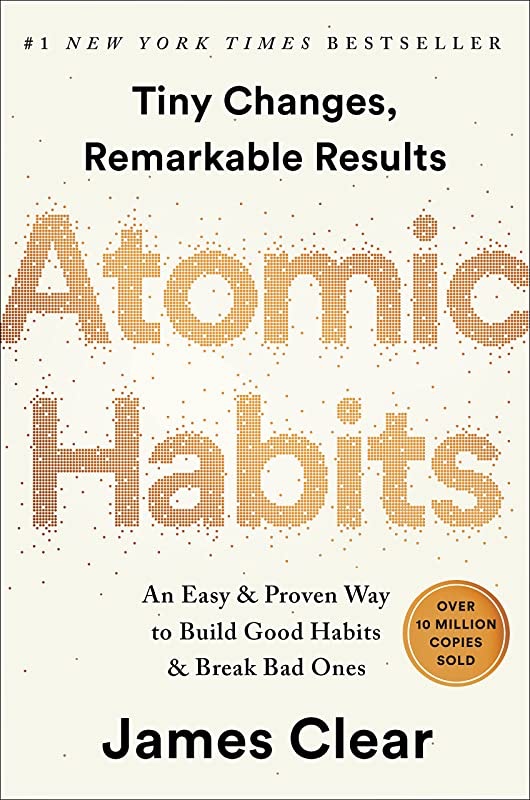
The book is written by James Clear, who is an author and speaker focused on habits, decision-making, and continuous improvement. His work has appeared in The New York Times, Time, and Entrepreneur, among others.
I read this book right after it was published back in 2018, but had a chance to put together this review in 2021 when I looked back at it again. The twelve main takeaways that I got out of this book are presented below:
- It is so easy to overestimate the importance of one defining moment and underestimate the value of making small improvements on a daily basis. Too often, we convince ourselves that massive success requires massive action. Whether it is losing weight, building a business, writing a book, winning a championship, or achieving any other goal, we put pressure on ourselves to make some earth-shattering improvement that everyone will talk about.
- If you save a little money now, you’re still not a millionaire. If you go to the gym three days in a row, you’re still out of shape. If you study Mandarin for an hour tonight, you still haven’t learned the language. We make a few changes, but the results never seem to come quickly and so we slide back into our previous routines…
- But when we repeat 1 percent errors, day after day, by replicating & poor decisions, duplicating tiny mistakes, and rationalizing little excuses, our small choices compound into toxic results. It’s the accumulation of many missteps-a 1 percent decline here and there–that eventually leads to a problem. The impact created by a change in your habits is similar to the effect of shifting the route of an airplane by just a few degrees. Imagine you are flying from Los Angeles to New York City. If a pilot leaving from LAX adjusts the heading just 3.5 degrees south, you will land in Washington, D.C., instead of New York. Such a small change is barely noticeable at takeoff–the nose of the airplane moves just a few feet – but when magnified across the entire United States, you end up hundreds of miles apart.
- Your outcomes are a lagging measure of your habits. Your net worth is a lagging measure of your financial habits. Your weight is a lagging measure of your eating habits. Your knowledge is a lagging measure of your learning habits. Your clutter is a lagging measure of your cleaning habits. You get what you repeat… Habits are a double-edged sword. Bad habits can cut you down just as easily as good habits can build you up, which is why understanding the details is crucial. You need to know how habits work and how to design them to your liking, so you can avoid the dangerous half of the blade.
- Goals are good for setting a direction, but systems are best for making progress. A handful of problems arise when you spend too much time thinking about your goals and not enough time designing your systems… The problem with a goals-first mentality is that you’re continually putting happiness off until the next milestone… goals create an “either-or” conflict: either you achieve your goal and are successful or you fail and you are a disappointment. You mentally box yourself into a narrow version of happiness… When you fall in love with the process rather than the product, you don’t have to wait to give yourself permission to be happy. You can be satisfied anytime your system is running.
- Focusing on the overall system, rather than a single goal, is one of the core themes of this book. It is also one of the deeper meanings behind the word atomic. An atomic habit refers to a tiny change, a marginal gain, a 1 percent improvement. But atomic habits are not just any old habits, however small. They are little habits that are part of a larger system. Just as atoms are the building blocks of molecules, atomic habits are the building blocks of remarkable results.
- Once your habits are established, they seem to stick around forever – especially the unwanted ones. Despite our best in-tentions, unhealthy habits like eating junk food, watching too much television, procrastinating, and smoking can feel impossible to break… Changing our habits is challenging for two reasons: (1) we try to change the wrong thing and (2) we try to change our habits in the wrong way… It’s hard to change your habits if you never change the underlying beliefs that led to your past behavior. You have a new goal and a new plan, but you haven’t changed who you are… The ultimate form of intrinsic motivation is when a habit becomes part of your identity. It’s one thing to say I’m the type of person who wants this. It’s something very different to say I’m the type of person who is this… Your identity is literally your “repeated beingness…” I didn’t start out as a writer. I became one through my habits.
- A habit is a behavior that has been repeated enough times to become automatic… Many people think they lack motivation when what they really lack is clarity. It is not always obvious when and where to take action… One of the most practical ways to eliminate a bad habit is to reduce exposure to the cue that causes it… The strategy is to pair an action you want to do with an action you need to do.
- As Charles Darwin noted, “In the long history of humankind, those who learned to collaborate and improvise most effectively have prevailed.” As a result, one of the deepest human desires is to belong. And this ancient preference exerts a powerful influence on our modern behavior. We don’t choose our earliest habits, we imitate them. One of the most effective things you can do to build better habits is to join a culture where your desired behavior is the normal behavior… Nothing sustains motivation better than belonging to the tribe. It transforms a personal quest into a shared one. Previously, you were on your own. Your identity was singular.
- You don’t actually want the habit itself. What you really want is the outcome the habit delivers… Researchers estimate that 40 to 50 percent of our actions on any given day are done out of habit… Habits are automatic choices that influence the conscious decisions that follow…
- One of the most satisfying feelings is the feeling of making progress… A habit tracker is a simple way to measure whether you did a habit-like marking an X on a calendar… Habit trackers and other visual forms of measurement can make your habits satisfying by providing clear evidence of your progress… Don’t break the chain. Try to keep your habit streak alive… Never miss twice. If you miss one day, try to get back on track as quickly as possible… Just because you can measure something doesn’t mean it’s the most important thing.
- This is a continuous process. There is no finish line. There is no permanent solution. Whenever you’re looking to improve, you can rotate through the Four Laws of Behavior Change until you find the next bottleneck. Make it obvious. Make it attractive. Make it easy. Make it satisfying. Round and round. Always looking for the next way to get 1 percent better… The secret to getting results that last is to never stop making improvements. It’s remarkable what you can build if you just don’t stop… It’s remarkable the business you can build if you don’t stop working… It’s remarkable the body you can build if you don’t stop training… It’s remarkable the knowledge you can build if you don’t stop learning… It’s remarkable the fortune you can build if you don’t stop saving… It’s remarkable the friendships you can build if you don’t stop caring. Small habits don’t add up. They compound.
 Marco Serrato
Leave a comment