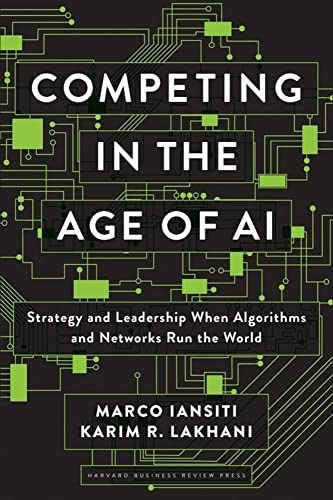
The book, written by Marco Iansiti and Karim R. Lakhani, shows how reinventing a firm around data, analytics and AI removes traditional constraints on scale, scope, and learning that have restricted business growth for hundreds of years. From Airbnb to Ant Financial, Microsoft to Amazon, their research shows how Al-driven processes are vastly more scalable than traditional processes, allow massive scope increase, enabling companies to straddle industry boundaries, and create powerful opportunities for learning–to drive ever more accurate, complex, and sophisticated predictions.
The twenty main takeaways I got out of this book are presented below
1. COVID-19 and organizations – the only lifesaving strategies involve a clear recognition of the threat, an immediate response, and thoughtful planning for long-term transformation… organizations that were responding most effectively to the pandemic illustrated that. Whether they were old or new, these organizations made use of a deep and integrated foundation of data to power operational decision making, with the help of software, analytics, and AI… So every organization should get to work now to digitize and structure its processes, systems, and capabilities to accelerate operational scale, scope, and learning. There is no longer any rationale for waiting. It doesn’t matter if your organization is new or old. Ultimately, if the virus doesn’t get you, your competitors will… During the two weeks between March 14 and March 30, 2020, the United States may have experienced more digital transformation than it had witnessed during the previous ten years. Workers representing more than half of the US economy started working from home. In the span of two weeks at our home institution, Harvard Business School, more than 125 faculty and 250 staff worked tirelessly to move education online for about 2,000 MBA and doctoral students. Some of us had believed that a change of this magnitude would take decades… We thought we would have some time to develop a new generation of leaders that could embrace the digital world across the economy and fully understand the capabilities and ethics needed for transformation. Covid-19 took this luxury away from us… However, we also learned how, for meaningful transformation to occur, planning and preparation really improve the quality and impact of the actions.
2. Simple algorithms, powered by the right data, can achieve critical results. Simple chat bots and basic machine learning can make a really big difference if they relieve critical operational bottlenecks or enable important predictions. Transformation has not come without its costs. Covid-19 has dramatically accelerated and deepened the impact of digital scale, scope, and learning on the world economy and society. Of most concern is perhaps the impact of Covid-19 on the digital divide between the haves and the have-nots firms as well as individuals. Beyond an impact on competitiveness, productivity, and income, the digital divide now defines the difference between those who can work and those who can’t, between those who can remain safe at home and those who cannot, between the firms that are still in business and those that are not. Deepening the tragedy, the divide is accentuating traditional economic and racial inequalities.
3. The Next Rembrandt – through its Arts and Machine Intelligence (AMI) program, for example, Google is organizing a community of artists and engineers to explore how creative practices are being transformed… Ahmed Elgammal, director of the Art & Artificial Intelligence Lab at Rutgers University, is working with an art-generating algorithm called AICAN that is programmed to produce novelty without substantial help from human artists.
4. Competing in the Age of AI – the first truly dramatic implications of artificial intelligence may be less a function of simulating human nature and more a function of transforming the nature of organizations and the ways they shape the world around us.
5. Business Models. A company’s business model would therefore defined by how it creates and captures value from its customers. And it is important to be precise. There are two elements that come together: first, the company must create value for a customer that prompts her to consume the company’s product or service; second, the company must deploy some method to capture some of the value created. Value creation, then, concerns the reason customers choose to use a company’s products or services, and the particular problem the company is solving for customers. This is sometimes known as the value proposition or customer promise. Think of the car you drive. The auto company’s value creation starts with solving your transportation problem.
6. Operating Models. Operating models deliver the value promised to customers. Whereas the business model creates a goal for value creation and capture, the operating model is the plan to get it done. As such, the operating model is crucial in shaping the actual value of the firm. A firm could promise to have an online retail business with nearly instant delivery; but to actualize that promise, the firm would need an impressive operating model characterized by an incredibly responsive supply chain. Devising and executing that operating model is where the real work would lie. Operating models can be very complex, frequently including the activities of thousands of people, sophisticated technology, important capital investments, and millions of lines of code that make up the operational systems and processes that enable a company to achieve its goals. But the overarching objectives of an operating model are relatively simple. Ultimately, the goal of an operating model is to deliver value at scale, to achieve sufficient scope, and to respond to changes by engaging in sufficient learning. The great business historian Alfred Chandler argued that the two main challenges faced by executives are to drive economies of both scale and scope in order to survive and thrive. Subsequent work in economics and management showed that a third challenge is equally important: learning the operating capability to improve and innovate.
7. The AI Factory. Through much of history, products were painstakingly and individually crafted in artisanal workshops. That ended when the Industrial Revolution transformed the economy by spawning a scalable and repeatable approach to manufacturing. Engineers and managers became experts at understanding the processes needed for mass production and built the first generation of factories, dedicated to the continuous, low-cost production of quality goods. However, while production was industrialized, analysis and decision making remained largely traditional, idiosyncratic processes. Now, the age of AI is manifested by companies driving another fundamental transformation. This one involves industrializing data gathering, analytics, and decision making to reinvent the core of the modern firm, in what we call the “Al factory.” The Al factory is the scalable decision engine that powers the digital operating model of the twenty-first-century firm. Managerial decisions are increasingly embedded in software, which digitizes many processes that have traditionally been carried out by employees.
8. Data pipeline: This process gathers, inputs, cleans, integrates, processes, and safeguards data in a systematic, sustainable, and scalable way. Algorithm development: The algorithms generate predictions about future states or actions of the business. These algorithms and predictions are the beating heart of the digital
firm, driving its most critical operating activities. Experimentation platform: This is the mechanism through which hypotheses regarding new prediction and decision algorithms are tested to ensure that changes suggested are having the intended (causal) effect. Software infrastructure: These systems embed the pipeline in a consistent and componentized software and computing infrastructure, and connect it as needed and appropriate to internal and external users.
9. Supervised Learning. The basic goal of supervised machine learning algorithms is to come as close as possible to a human expert (or an accepted source of truth) in predicting an outcome. The classic case is analyzing a picture and predicting whether the subject is a cat or a dog. In this case the expert would be any human being who could label photos as images of a cat or a dog. The algorithms in this class of machine learning systems rely on an expert-labeled dataset of the outcome (the Y) and the potential characteristics or features (the Xs). The operationalization of the algorithm is called a model, which takes
the general-purpose statistical approach and creates a context-specific instantiation of the prediction problem that needs to be solved.
10. Unsupervised Learning. Unlike supervised learning models, which train a system to recognize known outcomes, the primary application of unsupervised learning algorithms is to discover insights in data with few preconceptions or assumptions. This is what Netflix does when it discovers related groups of customers in analyzed viewing data, when it creates customer segments for marketing campaigns, or when it
creates different versions of the user interface that match different usage patterns… An unsupervised learning algorithm does not
suggest specific labels but rather establishes the most robust statistical groupings. Humans, or other algorithms, do the rest.
11. Reinforcement Learning. Although they are still relatively underdeveloped, the potential applications of reinforcement learning may be even more impactful than those of supervised and unsupervised learning. Rather than start with data on an expert’s view of the outcome, as in supervised learning, or with a pattern-and-anomaly recognition system, as in unsupervised learning, reinforcement learning requires only a starting point and a performance function. We start somewhere and probe the space around us, using as a guide whether we have improved or worsened our position. The key trade-off is whether to spend more time exploring the complex world around us or exploiting the model we have built so far to drive decisions and actions.
12. Five Principles for Transformation (FPT) – One Strategy. The first essential principle in transformation is to develop strategy clarity and commitment. The goals should be stated clearly, as in building an integrated data platform or organizing as agile teams. There is plenty of interest in digital transformation. But to operationalize a new strategy, especially one involving transformation, it’s imperative that there be no doubt as to the seriousness of the effort, its sustaining power, and the clarity of the end goal. Aligning the organization around a fundamental transformation is difficult enough.
13. FPT – Architectural Clarity. Second, it’s critical to bring clarity to the technical goals of the transformation. Everyone must understand what you want your future operating architecture to look like. A strong focus on data, analytics, and Al requires some centralization and much consistency. Data assets must be integrated across the range of applications for an organization to realize the full benefit of the transformation.
14. FPT – Agile, Product-Focused Organization. Developing a product-focused mentality is essential to an Al centered operating model. The teams deploying AI-centered applications must embed a deep understanding of the application settings they are designed to enable, as with any product-focused effort. That’s why at Amazon and Microsoft, highly experienced engineering leaders who’d run major product businesses were tasked with building the software necessary to rearchitect each company’s operating model.
15. FPT – Capability Foundations. The most obvious challenge in building an Al-centered firm is to grow a deep foundation of capability in software, data sciences, and advanced analytics. Naturally, building this foundation will take time, but much can be done with a small number of motivated, knowledgeable people. More challenging may be the realization that the organization needs to systematically hire a different kind of person and build an appropriate career path and incentive system. If the organization is serious about transformation, traditional practices will need to be changed, because the market for this kind of talent is hot. However, experience from Microsoft to Fidelity has shown that with the right process and incentives, analytics groups can be built and motivated quickly.
16. FPT – Clear, Multidisciplinary Governance. Digital governance should therefore involve a collaboration across disparate disciplines and functions. In doing so, it rejuvenates the role of legal and corporate affairs, whose people can be involved in product and policy decisions and not only participating in litigation and lobbying activities. AI requires deep thinking about legal and ethical exposure, and these activities should be actively staffed and supported.
17. Strategy for a new age. The strategic dynamics of AI and networks go hand in hand. As collisions between digital and traditional firms transform industries, and as firms develop increasingly digital foundations, the architecture of the economy is being reconfigured into a huge, all encompassing, Al-powered network consisting of an array of
subnetworks- social networks, supply chain networks, and mobile app networks, to name a few… A collision occurs when a firm with a digital operating model targets an application (or use case) that has traditionally been served by a more conventional firm. Note that it can take quite a while for digital operating models to generate economic value that comes anywhere near the value generated by traditional operating models… Take the global travel industry, where Airbnb is colliding with hotel companies like Marriott and Hilton. Airbnb serves similar needs but is built on a completely different kind of operating model. While Marriott and Hilton own and manage properties, with tens of thousands of employees in separate organizations devoted to enabling and shaping customer experiences, Airbnb’s lean organization sits on top of a virtual Al factory, aggregating data and using carefully crafted algorithms to match users to its digitally tracked and managed community of property owners.
18. Entertainment. The first organization to compete using a data- and software-centric operating model to collide successfully with the entertainment industry may have been Napster, which allowed people to digitize and share their music online for free–without any of the usual payments to the various players in the music industry. When it emerged in the late 1990s, it introduced music as a service. Despite its immense popularity, Napster was plagued by legal troubles and shut down in 2001. After Napster, Apple Music, Spotify, and others sparked new collisions with traditional music distribution companies, transforming the business and operating models for music distribution in the United States and beyond… The transformation of entertainment reveals other interesting patterns. First, the original innovator in a given industry does not always win; Napster is long gone. Deploying a digital operating
model is not enough. For a collision to threaten established players, the innovator needs an effective business model as well. AddiTionally, as they compete with traditional companies, digital firms compete with each other. As they do so, they may emerge as focused competitors like Netflix, or they may leverage synergies in assets and capabilities across industries, like Amazon and Apple. The winners and level of concentration in each market will be shaped by the resulting economies of scale, scope, and learning.
19. Clearly, the power of platforms like YouTube and Baidu to propagate and target information is also what makes them an engine for weaponizing misinformation and stoking bias. The same factors that drive a digital firm’s ability to get increasing returns to scale, scope, and learning can also have significant negative effects. As a result, digital operating models are prompting new kinds of ethical considerations and transforming the issues confronted by managers. The learning algorithms at the heart of new digital systems can be misused to tailor, optimize, and amplify inaccurate and harmful information, from targeting and shaping misleading ads to creating highly realistic fake social personas that are used to extract personal information from users. And the enormous data sets needed to fuel AI are also vulnerable to cyberattack, threatening consumer privacy by putting all sorts of sensitive information at risk… We group these challenges into five main categories: digital amplification, bias, security, control, and inequality.
20. We live in an important moment in the history of our economy and society. As digital networks and AI increasingly capture our world we are seeing a fundamental transformation in the nature of firms.
This removes historical constraints on scale, scope, and learning and creates both enormous opportunity and extraordinary turbulence. But despite all this newfound digital automation, it seems that we can’t quite do away with management just yet. The challenges are just too great, too complex, and too amorphous to be solved by technology (or technologists) alone. But leading through
these changing times will require a new kind of managerial wisdom, to steer organizations from full-scale firms to new ventures, and from regulatory institutions to communities.
 Marco Serrato
Leave a comment