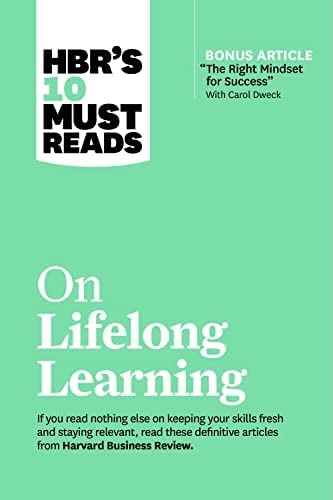
This book is part of Harvard Business Review’s (HBR) series and presents a collection of articles on lifelong learning. The ten main takeaways I got out of them are presented below:
1. Learning to Learn. Organizations today are in constant flux. Industries are consolidating, new business models are emerging, new technologies are being developed, and consumer behaviors are evolving. For executives, the ever-increasing pace of change can be especially demanding. It forces them to understand and quickly respond to big shifts in the way companies operate and how work must get done. In the words of Arie de Gus, a business theorist, “The ability to learn faster than your competitors may be the only sustainable competitive advantage.” This is about resisting the bias against doing new things, scanning the horizon for growth opportunities, and pushing yourself to acquire radically different capabilities-while still performing your job. That requires a willingness to experiment and become a novice again and again: an extremely discomforting notion for most of us… There are four key attributes: aspiration, self-
awareness, curiosity, and vulnerability.
2. Aspiration. It’s easy to see aspiration as either there or not: You want to learn a new skill or you don’t; you have ambition and motivation or you lack them… When confronted with new learning, this is often our first roadblock: We focus on the negative and unconsciously reinforce our lack of aspiration. When we do want to learn something, we focus on the positive. What we’ll gain from learning it-and envision a happy future in which we’re reaping those rewards. That propels us into action. Researchers have found that shifting your focus from challenges
to benefits is a good way to increase your aspiration to do initially unappealing things.
3. Self-awareness. Over the past decade or so, most leaders have grown familiar with the concept of self-awareness. They understand that they need to solicit feedback and recognize how others see them. But when it comes to the need for learning, our assessments of ourselves-what we know and don’t know, skills we have and don’t have-can still be woefully inaccurate.
4. Curiosity. Curiosity is what makes us try something until we can do it, or think about something until we understand it. Great learners retain this childhood drive, or regain it through another application of self-talk. Instead of focusing on and reinforcing initial disinterest in a new subject, they learn to ask themselves “curious questions” about it and follow those questions up with actions.
5. Vulnerability. Generally, when we’re trying something new and doing badly at it, we think terrible thoughts: I hate this. I’m such an idiot. I’ll never get this right. This is so frustrating! That static in our brains leaves little bandwidth for learning. The ideal mindset for a beginner is both vulnerable and balanced: I’m going to be bad at this to start with, because I’ve never done it before. AND I know I can learn to do it over time.
6. Teaching smart people how to learn. Any company that aspires to succeed in the tougher business environment must first resolve a basic dilemma: success in the marketplace increasingly depends on learning, yet most people don’t know how to learn. What’s more, those members of the organization that many assume to be the best at learning are, in fact, not very good at it. I am talking about the well-educated, high-powered, high-commitment professionals who occupy key leadership positions in the modern corporation… Put simply, because many professionals are almost always successful at what they do, they rarely experience failure. And because they have rarely failed, they have never learned how to learn from failure.
7. The leader as coach. The Situation: To cope with disruptive change, companies are reinventing themselves as learning organizations. This requires a new approach to management in which leaders serve as coaches to those they supervise. The Challenge: In this new approach, managers ask questions instead of providing answers, support employees instead of judging them, and facilitate their development instead of dictating what has to be done. But most managers don’t feel they have time for that – and they’re not very good at it anyway.
The Solution: Companies need to offer their managers the appropriate tools and support to become better coaches. And if they want to be
sustainably healthy learning organizations, they must also develop coaching as an organizational capacity.
8. Designing successful failures. Unsurprisingly, pilot projects are usually designed to succeed rather than to produce intelligent failures – those that generate valuable information. To know if you’ve designed a genuinely useful pilot, consider whether your managers can answer yes to the following questions: Is the pilot being tested under typical circumstances (rather than optimal conditions)? Do the employees, customers, and resources represent the firm’s real operating environment? Is the goal of the pilot to learn as much as possible (rather than to demonstrate the value of the proposed offering)? Is the goal of learning well understood by all employees and managers? Is it clear that compensation and performance reviews are not based on a successful outcome for the pilot? Were explicit changes made as a result of the pilot test?
9. Why organizations don’t learn. The Problem: Even companies dedicated to continuous improvement struggle to stay on the path. Research suggests that’s because of deeply ingrained biases: We focus too much on success, take action too quickly, try too hard to fit in, and depend too much on outside experts. The Impediments: These biases manifest themselves in 10 conditions that impede learning. These include fear of failure, insufficient reflection, believing that we need to conform, and inadequate frontline involvement in addressing problems. The Solutions: Leaders can use a variety of strategies to counter the biases, including stressing that mistakes are learning opportunities, building more breaks into schedules, helping employees identify and apply their personal strengths, and encouraging employees to own problems that affect them.
10. The transformer CLO. The Situation: The fast-changing nature of business today means that employees’ continual learning is vital for organizational success. The Response: Chief learning officers are assuming a more expansive role, aiming not only to train employees but also to transform their organizations’ capabilities and make learning an integral part of the company’s strategic agenda. The Specifics: Extensive interviews at 19 large companies revealed that “transformer CLOs”-those who are embracing this expanded role-are driving changes in their enterprises’ learning goals, learning methods,
and learning departments.
 Marco Serrato
Leave a comment