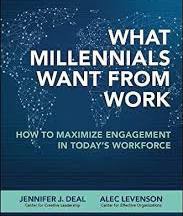
This book is written by Jeenifer J. Deal and Alec Levenson, who are part of the Center for Creative Leadership and the Center for Effective Organizations, respectively. I bought this book during a visit I made to the Center for Creative Leadership in North Carolina in 2017 and, while I read it back then, I did not post the review I made out of this book, which is presented below.
The twelve main takeaways that I got out of this book are presented below:
- Millennials are the future of several businesses over the next several years. How can managers and leaders of organizations better engage them to gain a competitive advantage?… Millennials have been burdened with a reputation as spoiled, lazy, and entitled, but the reality behind the stereotype is far richer and more complex.
- Who are Millennials and what do they really want? Based on fieldwork and survey data from global research on more than 25,000 Millennials and 29,000 older workers in 22 countries, this book paints a comprehensive, scientifically accurate picture of what really motivates Millennials around the world… Who We Are Calling Millennials? Throughout the book, the authors use “Millennials” to refer to a specific group of people, those born between 1980 and 2000. They have also been called Echo Boomers, Gen Y, and NetGen… Millennials have grown up with greater access to technology than earlier generations. They are typically proficient with new technology (some say addicted to technology and uninterested in human contact), and many people believe their skill with new technology makes Millennials an asset to organizations… Millennials have also been described as needy and entitled… Their detractors say that is because life was easy for them when they were growing up, at least in comparison with their parents… On the other hand, many of their families experienced financial hardship as a result of economic and social shifts. So some people posit that these hardships make Millennials skeptical of organizations in general and authority within organizations in particular… They have been derided as disloyal, uncommitted, and unwilling to work hard… However, the authors have found these stereotypes of Millennials to be largely the same everywhere. Though the details of the behaviors associated with these stereotypes might differ, the basics are consistent in all of the countries included in their research.
- Key strategies detailed in the book include: improving workplace flexibility because Millennials don’t separate life and work; providing adequate support and feedback because Millennials like to learn and grow; coaching, not micromanaging because Millennials value autonomy; designing competitive salary structures because Millennials know what’s up; providing opportunities to contribute to society because Millennials care about doing good; among others.
- Society has developed an unexpectedly complex picture of Millennials globally… The caricature-like descriptions we all have heard didn’t live up to the complex reality that the authors encountered during interviews and focus groups and what they saw in their collected data. They claim that their job (which they also frame as “their calling”) was to provide information that people at all levels in organizations could use to make themselves and their workplaces more effective. Based on this, the authors decided it was time for something different from the caricatures of Millennials.
- Who they studied: The survey data reported in this book come from just under 25,000 Millennial respondents from 22 countries: Brazil, Canada, China, the Czech Republic, France, Germany, India, Italy, Japan, Korea, Mexico, the Netherlands, Poland, Russia, Singapore, South Africa, Spain, Switzerland, Taiwan, the United Kingdom, the United Arab Emirates, and the United States. Those respondents work in more than 300 different organizations, most medium to large in size. All sectors of the economy are represented in the data set: government, non-profit, and for-profit. Industries include technology, food service, retail, aerospace, manufacturing, and professional services, among others. The majority of the survey data comes from organizations in the professional services industry, which is also where the authors conducted most of the interviews and focus groups. While their data are global, the majority of survey responses are from the United States.
- In general, the authors find that Millennials around the globe have remarkably similar perceptions about the workplace. Differences show up in how strongly people respond to a certain topic, not the direction of the belief. And the differences are largely a function of individuals’ economic environments. For example, all Millennials keep an eye out for newopportunities, and well-educated Millennials in developing economies (e.g., Brazil, India, and China) often have more opportunities to change jobs than those in economies which are more mature (e.g., France). Where the authors saw interesting country differences in the global data, they made note of it throughout the book.
- Overall, the authors outline that Millennials want a satisfying job that pays well, coworkers they like and trust, advancement opportunities, and the occasional pat on the back. However, my personal questioning would be “who doesn’t want those things?” Nonetheless, they outline valuable insights to explain this within the Millennial generation context, based on the data and insights they collected.
- Generalizations are not always true, including this one. As the authors, outline, no matter how many people you survey and interview, and no matter how complex and apparently accurate your statistics are, there will always be some who don’t fit the general descriptions. In other words, no generalizations about people are always true, including the ones in this book… Why? Because there are always outliers people who don’t fit a generalization.
- Another valuable insight that provides a useful context on the overall data and information presented in the book, is the fact that, while the generalizations are generally applicable to Millennials, there isn’t one universal solution for how you address any one Millennial in every single context. In most cases, the insights and advice are applicable regardless of how you interact with Millennials – understanding them is fundamental to interacting with them effectively, whatever your level. However, each recommendation isn’t universally applicable, so the authors outline sections throughout the book with specific recommendations for working with Millennials and for managing Millennials. The information is general. How we apply it is specific.
- Much of what is true about Milennials also holds for Gen Xers and Baby Boomers. If you are a member of the Millennial generation reading the book, the authors claim to hope your response in many instances will be, “Yes! That’s so true. They get us!” And if you’re a member of an older generation, they expect your response in many cases will be, “Why are you saying this is just their generation? We asked for these things years ago! That’s what we said! That’s what we want, too!“
- The authors explain that in reality, a lot of what makes people tick doesn’t change from one generation to the next. In their research on Millennials, the authors discovered many interesting characteristics that make this generation unique. But they also found that in most ways, Millennials expectations about work are strikingly similar to those of other generations. In many cases, Millennials are continuing a decades-long tradition of pushing organizations to change. The authors provide information about what Millennials want from work because the purpose of the book is to describe who Millennials are. While they occasionally compare Millennials and older staff where they think the contrasts or similarities are particularly interesting, an exhaustive comparison is beyond the scope of this book. However, the authors believe the majority of the recommendations they make for managers will be as effective for Gen Xers and Baby Boomers as they are for Millennials.
- Overall, this book explains who Millennials really are, and offers practical advice to help those who manage, lead, and work with Millennials to improve teamwork, increase productivity, strengthen organizational culture, and build a robust talent pipeline.
 Marco Serrato
Leave a comment