
This is another Museum we visited in Istanbul, Turkey, over Summer 2022. Some highlights, out of the information presented in the museum, and photos are outlined below:
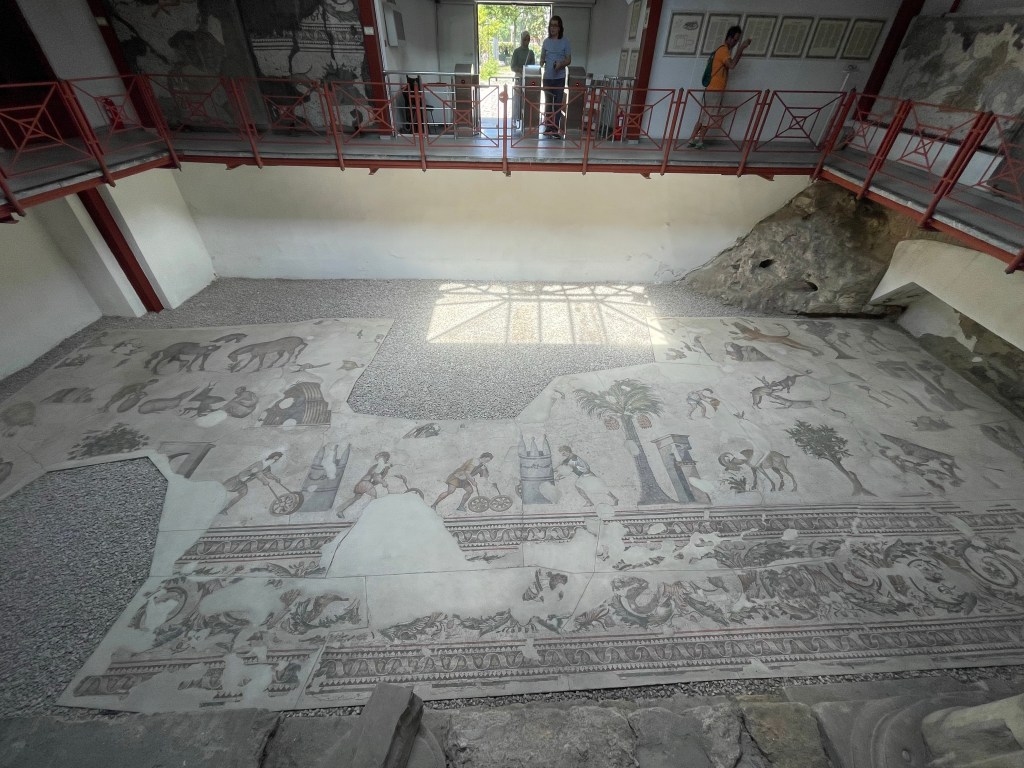
- Nowhere else in antiquity can we find a tessellated floor of quite the size and quality of the Great Palace Mosaic in Istanbul. This unique masterpiece also provides us with the single reference that we have of the furnishings of the Imperial Palace of Constantinople.
- At the time of its making, the mosaicist craft, rooted in Anatolia and artistically perfected in Greece and Italy, could draw on a long-established tradition. The best artists from all corners of the Empire were employed to lay this splendidly ornamented floor.
- With no comparable works available, it is, however, difficult to interpret and date the mosaic solely on the basis of typological and stylistic criteria.
- The mosaic floor was made up of three layers: the bottom stratum consisted of a thick (0.30 to 0.50 metres) bed of packed quarrystone (statumen), covered by a mortar screed of 9 cm in thickness topped by a compacted insulating layer of loam, soil and charcoal and a hard screed layer containing a high rate of stone chips (rudus), which in turn supported the embedding mortar and tesserae (nucleus).
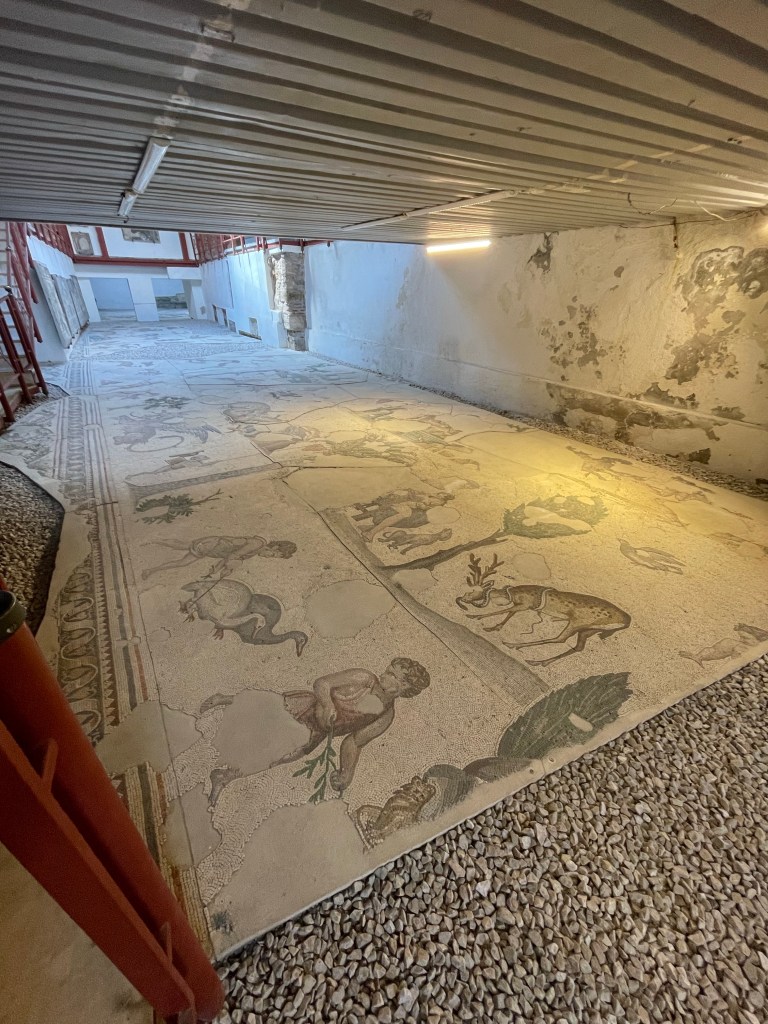
- The pavement required 75 to 80 million many-coloured lime, terracotta and glass cubes (some 40,000 cubes per square metre) of some 5 mm in average edge length. Due to destruction and numerous conversions since the days of Justinian I, only some 250 square metres of the floor survived in the south-western, northwestern and north-eastern halls of the peristylar court, about one seventh or one eighth of the original expanse.
- In spite of its fragmented state, the unearthed parts of the mosaic suffice to give us an impression of the splendor common in early Byzantine palaces. The continuous section of the north-eastern hall in particular, which was returned in situ after its successful restoration, provides an excellent view of the technical, artistic and iconographical details of the tessellated pavement.
- The main panel of the surviving 170 to 180 square metres of ornamental pavement has a depth of 6 metres and consists of a vibrantly coloured gallery of scenes arranged in four strips of friezes. Either side of its edge is accompanied by an exquisitely arranged border of foliage, each 1.50 metres wide.
- A highly naturalistic acanthus scroll appears to have been regularly interspersed by larger-than-life masked heads.
- There are leitmotiv-like references to nature and scenery, to the world of Dionysos. On both sides of the luxuriantly swirling acanthus, filled with exotic fruits and animals, runs a multi-coloured scroll almost three-dimensional in effect, with delicate geometric borders.
- The populated scenery was to be viewed from the courtyard side of the peristyle. The scenes are not limited to a single row, but will occasionally stray into a neighbouring row, e.g. trees that form part of the story of a scene.
- The scenes show a movement from left to right in the north-eastern and south-western hall, i.e. pointing towards the Palace Aula in the south-east.
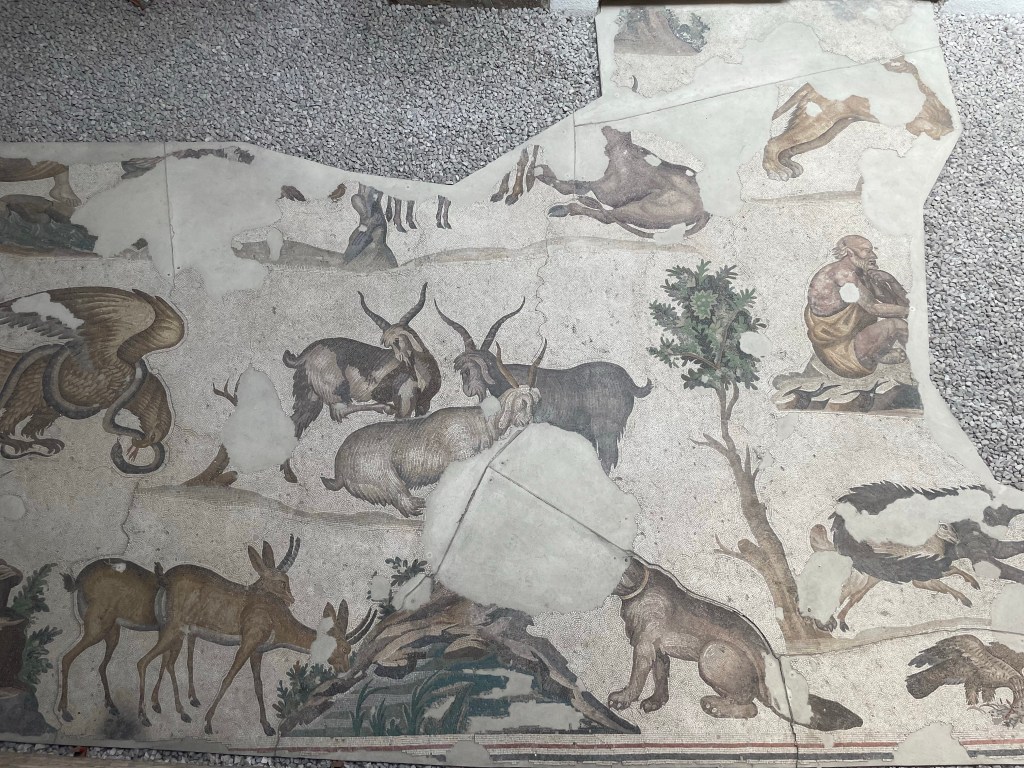
- The pictures describe the animal kingdom, hunting and playing, bucolic scenes, landscapes and legends.
- On the surviving parts of the mosaic we still count 150 human and animal figures.
 Marco Serrato
Leave a comment