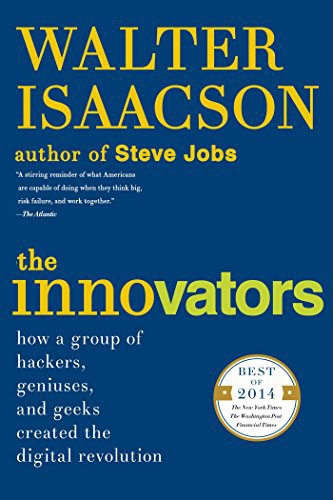
The book is written by Walter Isaacson and aims to outline the story of the innovations that created the digital age, including many strands within them. While the ten top takeaways that I got out of this book are outlined below, I could say that the main one, as presented by the author, is that creativity is a collaborative process and that innovation comes from teams more often than from the lightbulb moments of lone geniuses.
- The Scientific Revolution, the Enlightenment, and the Industrial Revolution all had their institutions for collaborative work and their networks for sharing ideas. But to an even greater extent, this has been true of the digital age.
- As brilliant as the many inventors of the Internet and computer were, they achieved most of their advances through teamwork. Like Robert Noyce, some of the best of them tended to resemble Congregational ministers rather than lonely prophets, madrigal singers rather than soloists.
- Therein lies another lesson the digital age may seem revolutionary, but it was based on expanding the ideas handed down from previous generations. The collaboration was not merely among contemporaries, but also between generations. The best innovators were those who understood the trajectory of technological change and took the baton from innovators who preceded them. Steve Jobs built on the work of Alan Kay, who built on Doug Engelbart, who built on J. C. R. Lick-lider and Vannevar Bush. When Howard Aiken was devising his digi tal computer at Harvard, he was inspired by a fragment of Charles Babbage’s Difference Engine that he found, and he made his crew members read Ada Lovelace’s “Notes.
- The most productive teams were those that brought together people with a wide array of specialties. Bell Labs was a classic example. In its long corridors in suburban New Jersey, there were theoretical physicists, experimentalists, material scientists, engineers, a few businessmen, and even some telephone-pole climbers with grease under their fingernails. Walter Brattain, an experimentalist, and John Bardeen, a theorist, shared a workspace, like a librettist and a composer sharing a piano bench, so they could perform a call-and-response all day about how to make what became the first transistor.
- Throughout history the best leadership has come from teams that combined people with complementary styles. That was the case with the founding of the United States. The leaders included an icon of ratitude, George Washington; brilliant thinkers such as Thomas Jeferson and James Madison; men of vision and passion, including Samuel and John Adams; and a sage conciliator, Benjamin Franklin.
- Likewise, the founders of the ARPANET included visionaries such as Licklider, crisp decision-making engineers such as Larry Roberts, politically adroit people handlers such as Bob Taylor, and collaborative oarsmen such as Steve Crocker and Vint Cerf.
- Another key to fielding a great team is pairing visionaries, who can generate ideas, with operating managers, who can execute them. Visions without execution are hallucinations. Robert Noyce and Gordon Moore were both visionaries, which is why it was important that their first hire at Intel was Andy Grove, who knew how to impose crisp management procedures, force people to focus, and get things done.
- The Internet facilitated collaboration not only within teams but also among crowds of people who didn’t know each other. This is the advance that is closest to being revolutionary. Networks for collaboration have existed ever since the Persians and Assyrians invented postal systems. But never before has it been easy to solicit and collate contributions from thousands or millions of unknown collaborators. This led to innovative systems Google page ranks, Wikipedia entries, the Firefox browser, the GNU/Linux software -based on the collective wisdom of crowds.
- Much of the first round of innovation involved pouring old wine – books, newspapers, opinion pieces, journals, songs, television shows, movies – into new digital bottles. But new platforms, services, and social networks are increasingly enabling fresh opportunities for individual imagination and collaborative creativity. Role-playing games and interactive plays are merging with collaborative forms of storytelling and augmented realities. This interplay between technology and the arts will eventually result in completely new forms of expression and formats of media.
- This innovation will come from people who are able to link beauty to engineering, humanity to technology, and poetry to processors. In other words, it will come from the spiritual heirs of Ada Lovelace, creators who can flourish where the arts intersect with the sciences and who have a rebellious sense of wonder that opens them to the beauty of both.
 Marco Serrato
Leave a comment